
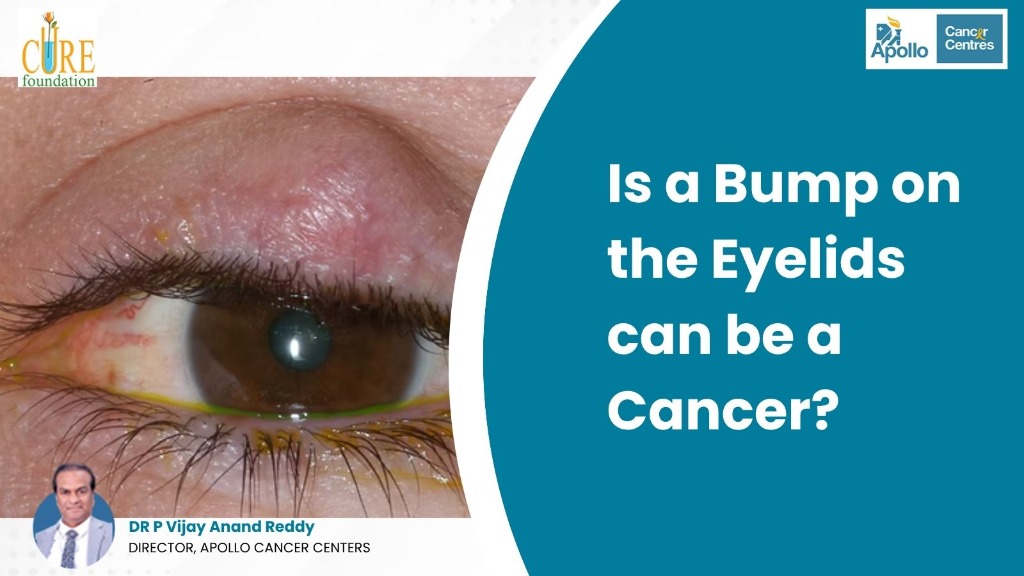
Is a Bump on the Eyelids Can Be a Cancer? Causes, Symptoms & Treatment
Dr. Vijay Anand Reddy
Consultant Oncologist • AI-Assisted Educational Resource
Medical Disclaimer: This article is AI-assisted and intended for general informational purposes only. It does not replace professional medical advice, diagnosis, or treatment. Please consult a qualified healthcare specialist for advice specific to your condition.
Quick Answer: Can an Eyelid Bump Be Cancerous?
In most cases, a bump on the eyelid is a harmless, benign condition such as a stye or a chalazion (a blocked oil gland). However, if you are asking is a bump on the eyelids can be a cancer, the short medical answer is yes. Persistent, painless, slow-growing lumps that bleed, form crusts, cause eyelash loss, or recur after treatment may indicate an eyelid skin cancer such as basal cell carcinoma or sebaceous gland carcinoma. Prompt evaluation by an eye oncologist or dermatologist is essential to rule out malignancy and protect your sight.
Finding an unfamiliar lump or swelling on your eyelid can instantly cause concern. Because the skin around our eyes is remarkably thin and sensitive, even a small nodule can feel prominent. While most eyelid lumps disappear on their own or with warm compresses, persistent or unusual growths require clinical evaluation from the best oncologist in hyderabad to ensure early detection and peace of mind.
In this guide, Dr. P. Vijay Anand Reddy, leading radiation oncologist and Director of Apollo Cancer Centres, explains common non-cancerous causes of eyelid lumps, key red flags of malignant tumors, how a bump on eyelid cancer is diagnosed, and modern treatment options available today.
Understanding Eyelid Bumps: Benign vs. Malignant
The eyelids are composed of delicate skin, muscles, nerves, blood vessels, and specialized oil glands known as meibomian glands. These tissues shield the eye and maintain the tear film. Because eyelids face constant solar ultraviolet (UV) radiation and environmental factors, eyelid inflammation and gland blockages are common.
Before suspecting cancer, it is reassuring to know that benign conditions account for over 90% of all eyelid lumps seen in clinical practice.
1. Styes (Hordeolum)
A stye is a localized bacterial infection of an eyelash follicle or oil gland, typically caused by Staphylococcus bacteria. It presents as a red, tender, pus-filled pimple along the eyelid margin. Styes develop rapidly over 24 to 48 hours, cause tenderness, and resolve within 7 to 10 days with warm compresses.
2. Chalazion
A chalazion occurs when a meibomian oil gland becomes clogged by thickened secretions. Unlike a stye, a chalazion is typically painless and develops deeper within the eyelid as a firm, smooth nodule. While harmless, a chronic chalazion lasting longer than 4 to 6 weeks warrants evaluation to rule out underlying malignancy.
3. Xanthelasma
Xanthelasma appears as yellowish, soft, flat plaques near the inner corners of the eyelids. These represent cholesterol deposits beneath the skin. They are non-cancerous and painless, though they may indicate elevated blood cholesterol levels.
4. Benign Cysts and Papillomas
Skin tags (papillomas), sweat gland cysts (hydrocystomas), and benign moles (nevi) frequently appear on eyelids due to aging or sun exposure. These grow extremely slowly, do not bleed, and do not invade surrounding tissues.
When Is a Bump on the Eyelids Can Be a Cancer?
Although non-cancerous conditions dominate, malignant eyelid tumors do occur. So, when should you suspect that a bump on eyelid cancer might be present?
Eyelid cancer refers to malignant cell growth originating in the skin or gland structures of the lower or upper eyelid. Because eyelids receive significant lifetime solar UV exposure, they are vulnerable to cutaneous malignancies. Patients seeking specialized diagnosis and management for ocular growths can explore advanced Eye Cancer Treatment in Hyderabad at Apollo Cancer Centres, where comprehensive diagnostic tools ensure accurate evaluation.
Types of Eyelid Cancer
- Basal Cell Carcinoma (BCC): The most common eyelid skin cancer, accounting for 85% to 90% of cases. BCC most frequently develops on the lower eyelid or inner corner of the eye. It appears as a firm, pearly nodule with visible tiny blood vessels or a central crater that crusts and bleeds easily.
- Sebaceous Carcinoma: An aggressive cancer arising from meibomian oil glands. It is particularly noteworthy when evaluating a bump on upper eyelid cancer because the upper eyelid contains a high concentration of oil glands. Sebaceous carcinoma frequently presents as a painless lump that closely resembles a recurrent chalazion or chronic blepharitis.
- Squamous Cell Carcinoma (SCC): Accounting for about 5% of eyelid malignancies, SCC grows faster than BCC and carries a higher risk of spreading to nearby lymph nodes or deeper orbital tissues. It often presents as a rough, scaly nodule or non-healing ulcerated sore.
- Melanoma of the Eyelid: A rare but serious skin cancer developing from melanocytes. It presents as an irregularly shaped brown, black, or multi-colored nodule along the eyelid.
Medical research documented on Wikipedia's eyelid tumor reference emphasizes that early histological examination through a biopsy is the single most reliable method for distinguishing benign eyelid bumps from malignant neoplasms.
Warning Signs of Eyelid Cancer vs. Benign Bumps
Compare the key clinical differences between benign lumps and potential eyelid cancers in the table below:
| Clinical Feature | Benign Bump (Stye / Chalazion) | Potential Eyelid Cancer |
|---|---|---|
| Onset & Growth Rate | Appears rapidly over days; quickly stabilizes or shrinks. | Grows slowly and continuously over months or years. |
| Pain & Tenderness | Often tender, painful, or sore to touch (styes). | Usually painless during early and intermediate stages. |
| Ulceration & Bleeding | Rarely bleeds; may release pus. | Forms a central crust, bleeds easily, or fails to heal. |
| Eyelash Loss (Madarosis) | Eyelashes remain intact and healthy. | Causes localized loss, breakage, or misdirection of eyelashes. |
| Response to Treatment | Resolves with warm compresses or minor drainage. | Persists or recurs repeatedly in the exact same spot after drainage. |
| Border & Appearance | Smooth red bump or uniform rounded nodule. | Pearly border, central crater, scaly patch, or irregular edges. |
Why a Bump on Upper Eyelid Cancer Is Often Misdiagnosed
A critical challenge in ocular oncology involves a bump on upper eyelid cancer. Because chalazions occur frequently on the upper eyelid, patients and general practitioners often assume a persistent upper lid nodule is simply a stubborn chalazion.
Sebaceous carcinoma, which develops predominantly in upper eyelid meibomian glands, frequently masquerades as a chronic chalazion or blepharitis. If an upper eyelid bump does not resolve after 4 to 6 weeks of conservative therapy, or if it recurs immediately after surgical drainage, a biopsy must be performed without delay to prevent tumor infiltration into deeper orbital structures.
Key Risk Factors for Eyelid Malignancies
While anyone can develop an eyelid lump, several clinical risk factors increase the likelihood of eyelid skin cancer:
- Unprotected Sun & UV Exposure: Chronic exposure to solar ultraviolet (UV) rays without UV-blocking sunglasses or hats is a leading risk factor.
- Advancing Age: Incidence of basal cell, squamous cell, and sebaceous carcinoma rises significantly in individuals over 50.
- Fair Skin: Individuals with lighter skin pigmentation and blue/green eyes have less natural melanin protection against UV rays.
- Prior Skin Cancers: A personal history of skin cancer increases the risk of developing a lesion on the eyelids.
- Chronic Inflammation: Long-standing blepharitis or meibomian gland dysfunction can cause localized cellular stress.
- Immunosuppression: Compromised immune systems face elevated risks of cutaneous skin cancers.
How Eyelid Bumps and Cancers Are Diagnosed
When visiting a specialist with a persistent eyelid nodule, a comprehensive diagnostic evaluation is conducted by the best oncologist in hyderabad:
- Slit-Lamp Examination: High-magnification optical check of the eyelid margin, meibomian glands, and eyelashes.
- Biopsy: The gold standard for diagnosis. A small tissue specimen is removed under local anesthesia and analyzed under a microscope to confirm or rule out cancer cells.
- Imaging Studies (CT / MRI): If cancer is confirmed and appears deep, imaging checks for orbital or bone involvement.
Comprehensive Treatment Options for Eyelid Cancer
Treatment depends on tumor type, size, depth, and location. Modern oncology aims to achieve complete cure while preserving vision and facial symmetry through specialized Eye Cancer Treatment in Hyderabad.
1. Surgical Excision & Reconstruction
Mohs micrographic surgery or wide local excision with margin evaluation ensures complete tumor removal while saving healthy eyelid tissue. Oculoplastic reconstruction restores natural eyelid contour and blinking function.
2. Advanced Radiation Therapy
Radiation therapy plays a vital role when surgery carries high functional risk or for non-surgical candidates. Ultra-precise techniques like IMRT and IGRT target cancer cells while protecting the eye globe and lens.
3. Targeted Therapy & Immunotherapy
For advanced or recurrent skin cancers, modern systemic targeted therapies and immunotherapies offer effective non-surgical options.
Expert Care in Hyderabad
If you or a loved one is dealing with an unresolved eyelid nodule, consulting the best oncologist in hyderabad is essential for accurate diagnosis. Apollo Cancer Centres offers specialized services for Eye Cancer Treatment in Hyderabad with world-class technology and personalized care.
Home Care Best Practices: What You Should Do and Avoid
RECOMMENDED DO'S:
- Apply warm compresses (10-15 mins, 3-4 times daily) for suspected styes or chalazions.
- Wear UV400-rated sunglasses outdoors to shield eyelids from solar radiation.
- Maintain eyelid hygiene using gentle lid wipes if prone to blepharitis.
- Schedule a specialist consultation if any eyelid lump persists past 3 to 4 weeks.
CRITICAL DONT'S:
- Never squeeze, pop, or cut an eyelid bump to avoid infection or scarring.
- Avoid applying harsh acne creams or unverified home remedies directly to the eyelid.
- Refrain from wearing eye makeup or contact lenses while an active lump is present.
- Do not ignore a recurring bump that returns in the exact same spot after treatment.
Frequently Asked Questions (FAQs)
Q1. Is a bump on the eyelids can be a cancer?
Yes, while most eyelid bumps are benign styes or chalazions, a persistent, painless, slow-growing, or bleeding bump can be a sign of eyelid skin cancer, such as basal cell carcinoma or sebaceous gland carcinoma. Prompt medical evaluation is essential if a lump does not resolve within 4 weeks.
Q2. What does bump on upper eyelid cancer look like?
A bump on upper eyelid cancer frequently presents as a firm, painless nodule or a lesion resembling a chalazion. In cases of sebaceous carcinoma, it may cause localized eyelash loss (madarosis), eyelid margin thickening, ulceration, or crusting that fails to heal.
Q3. Can a chalazion turn into eyelid cancer?
No, a chalazion is a benign blocked oil gland and cannot convert into a malignant tumor. However, sebaceous carcinoma can closely mimic a chalazion. For this reason, any non-healing or recurrent "chalazion" should be evaluated with a biopsy.
Q4. How quickly does bump on eyelid cancer grow?
Most eyelid skin cancers progress slowly over several months or years. However, squamous cell carcinoma and sebaceous carcinoma grow more rapidly. Any lump showing continuous growth over weeks should be evaluated immediately.
Q5. Is eyelid cancer curable if caught early?
Yes! When detected early before spreading into orbital tissues, eyelid cancer has a cure rate exceeding 95% through specialized surgery or targeted radiation therapy.
Q6. When should I see a specialist for an eyelid bump?
You should consult an eye specialist or oncologist immediately if an eyelid bump persists longer than 3 to 4 weeks, bleeds easily, causes eyelash loss, impairs vision, or recurs after surgical drainage.
Final Thoughts & Expert Summary
Noticing a bump on your eyelid is generally not a reason for immediate panic, as most lumps stem from benign conditions like styes or clogged oil glands. However, remaining vigilant regarding long-lasting, painless, or unusual changes in your eyelids is crucial for preserving eye health and vision.
If you observe an eyelid nodule that fails to heal, bleeds, causes eyelash loss, or recurs after treatment, do not postpone expert medical evaluation. Early diagnostic biopsy and individualized care under experienced oncologists ensure peace of mind and excellent long-term health outcomes.
Frequently Asked Questions
Is a bump on the eyelids can be a cancer?
What does bump on upper eyelid cancer look like?
Can a chalazion turn into eyelid cancer?
How quickly does bump on eyelid cancer grow?
Is eyelid cancer curable if caught early?
When should I see a specialist for an eyelid bump?
Dr. Vijay Anand Reddy
Dr. Vijay Anand Reddy is a renowned oncologist with over 34 years of experience in cancer treatment. He is committed to providing world-class cancer care and spreading awareness about early detection and prevention.
View Full ProfileRelated Articles
Discover more insights about cancer awareness, treatment options, and patient stories.

Does Oral Cancer Spread? {Quick Guide}

Can a Blood Test Detect Prostate Cancer?

Can Teenagers get Breast Cancer? {2026 Guide}

How Long Can You Live with Blood Cancer Without Treatment?

Is Chemotherapy Painful for Breast Cancer? {Real Facts}
