
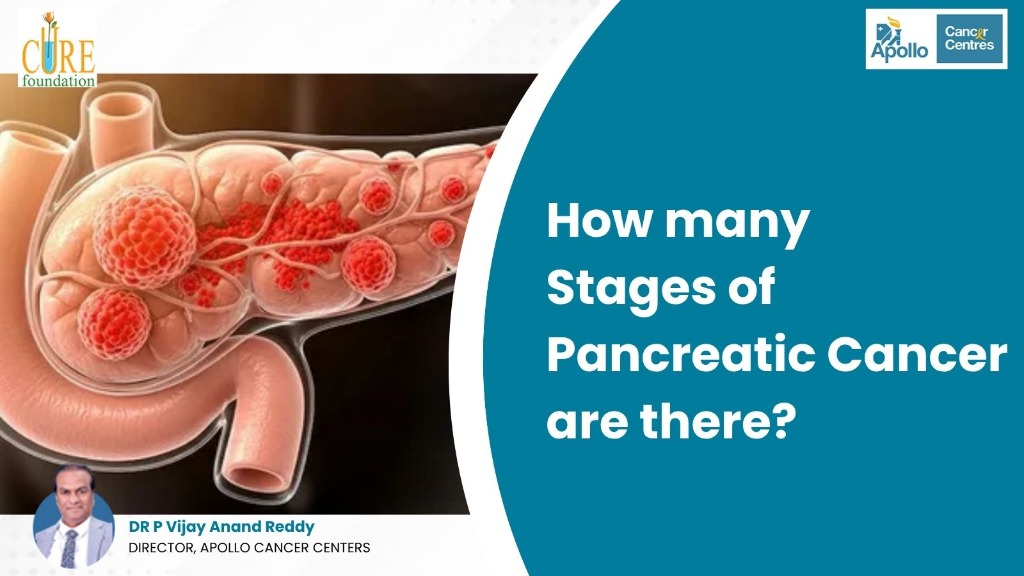
How many Stages of Pancreatic Cancer are there?
Dr. Vijay Anand Reddy
Oncologist
A diagnosis of pancreatic cancer can be an overwhelming and frightening experience. The pancreas, a gland located deep in the abdomen behind the stomach, plays a vital role in digestion and blood sugar regulation. Because of its location, tumors in the pancreas are difficult to detect early, often growing silently before causing symptoms. Once diagnosed, one of the most critical factors that doctors use to determine the course of action is the stage of the disease. Staging helps outline how large the tumor is, whether it has spread, and what treatment options are available. But exactly how many stages of pancreatic cancer are there, and what do they mean for a patient's prognosis and treatment path?
In this comprehensive guide, we will break down the staging of pancreatic cancer from Stage 0 (carcinoma in situ) to Stage 4 (metastatic disease). We will explore the staging systems used by oncologists, the symptoms associated with each stage, diagnostic methods, and the latest treatment options. For patients seeking world-class cancer care, understanding staging is the first step toward exploring options like advanced Pancreatic Cancer treatment in India. Collaborating with a highly experienced Oncologist in India, such as Dr. Vijay Anand Redy, ensures access to personalized multidisciplinary care plans that target the disease at its specific stage.
The Staging System: What is TNM?
To standardize how cancer is classified, oncologists worldwide use the American Joint Committee on Cancer (AJCC) TNM staging system. This system is primarily applied to exocrine pancreatic cancer, specifically pancreatic ductal adenocarcinoma (PDAC), which accounts for over 95% of all pancreatic cancer cases. The TNM system evaluates three key parameters:
- T (Tumor Size and Extent): Indicates the size of the primary tumor and whether it has grown outside the pancreas into nearby tissues, major blood vessels (such as the celiac axis or superior mesenteric artery), or organs.
- N (Lymph Nodes): Describes whether the cancer has spread to regional lymph nodes near the pancreas and, if so, how many lymph nodes are involved.
- M (Metastasis): Indicates whether the cancer has metastasized (spread) to distant organs or tissues, such as the liver, lungs, peritoneum (lining of the abdomen), or bones.
Once the T, N, and M categories are determined, they are combined to assign an overall stage, ranging from 0 to IV. Let's explore each of these stages in detail.
Stage 0: Carcinoma in Situ
Stage 0, also known as carcinoma in situ or pancreatic intraepithelial neoplasia (PanIN-3), is the earliest stage of pancreatic cancer. In this stage, abnormal cells are found only in the lining of the pancreatic ducts. These cells have not invaded deeper tissues or spread outside the duct, and there is no involvement of lymph nodes or distant organs (Tis, N0, M0).
Because Stage 0 cancer is completely localized and non-invasive, it does not cause symptoms and is virtually impossible to detect during routine screening. If it is found, it is usually an incidental finding during surgery or diagnostic testing for another condition. The treatment for Stage 0 is surgical removal of the affected portion of the pancreas, which is highly curative and carries an excellent long-term prognosis.
Stage I: Localized Pancreatic Cancer
In Stage I, the cancer is localized entirely within the pancreas. It has not grown into major blood vessels or spread to lymph nodes or distant organs (T1-T2, N0, M0). Stage I is subdivided into two categories based on the tumor size:
- Stage IA: The tumor is 2 centimeters (cm) or smaller in its greatest dimension (T1, N0, M0).
- Stage IB: The tumor is larger than 2 cm but not larger than 4 cm in its greatest dimension (T2, N0, M0).
Stage I cancers are considered resectable pancreatic cancer, meaning they can be surgically removed. The surgical procedure depends on the location of the tumor. Tumors in the head of the pancreas are treated with a Whipple procedure (pancreaticoduodenectomy), which involves removing the head of the pancreas, a portion of the small intestine, the gallbladder, and part of the bile duct. Tumors in the body or tail of the pancreas are treated with a distal pancreatectomy and splenectomy. Surgery is followed by adjuvant chemotherapy to eliminate any remaining microscopic cancer cells and reduce the risk of recurrence.
Stage II: Locally Advanced / Regional Spread
Stage II pancreatic cancer has grown larger or has spread to nearby regional lymph nodes, but it has not invaded major blood vessels or metastasized to distant organs. Stage II is subdivided into:
- Stage IIA: The tumor is larger than 4 cm in its greatest dimension but has not spread to nearby lymph nodes (T3, N0, M0).
- Stage IIB: The tumor is of any size and has spread to 1 to 3 nearby regional lymph nodes (T1-T3, N1, M0).
Depending on the precise location and relationship of the tumor to nearby blood vessels, Stage II cancers may be classified as either resectable or \"borderline resectable.\" Borderline resectable means the tumor is close to major blood vessels but might still be removable if it can be shrunk first. To achieve this, oncologists often recommend neoadjuvant therapy—chemotherapy or chemoradiation given before surgery—to shrink the tumor and increase the likelihood of a successful surgical resection. If the tumor responds well, surgery is performed, followed by further adjuvant treatment.
Stage III: Locally Advanced / Unresectable
Stage III represents a more advanced stage of local disease. The cancer has spread outside the pancreas into major nearby blood vessels (such as the celiac axis or superior mesenteric artery) or has spread to 4 or more regional lymph nodes (T4, Any N, M0 or Any T, N2, M0). Because the tumor has wrapped around or invaded critical blood vessels, Stage III pancreatic cancer is generally classified as locally advanced and surgically unresectable.
Symptoms at this stage are common and include persistent abdominal and back pain, significant weight loss, loss of appetite, and jaundice (yellowing of the skin and eyes) if the tumor blocks the bile duct. Since surgical removal is not a viable option initially, the primary goal of treatment is to control cancer growth, relieve symptoms, and prolong survival. Treatment typically involves systemic chemotherapy, sometimes combined with radiation therapy (chemoradiation). In a small percentage of cases, if the tumor shrinks significantly in response to chemotherapy, it may be reassessed for surgical resection.
Stage IV: Metastatic Pancreatic Cancer
Stage IV is the most advanced stage, commonly referred to as metastatic pancreatic cancer. At this stage, the cancer has spread beyond the pancreas and nearby tissues to distant organs, regardless of the tumor size or lymph node status (Any T, Any N, M1). The most common site of metastasis for pancreatic cancer is the liver, followed by the lungs, the peritoneum (the lining of the abdominal cavity), and distant lymph nodes.
Patients with Stage IV disease often experience severe symptoms, including profound fatigue, nausea, ascites (fluid accumulation in the abdomen), pain, and digestive blockages. Because the cancer has spread throughout the body, local treatments like surgery or radiation are not effective. Treatment focuses on systemic therapies, such as chemotherapy regimens (e.g., FOLFIRINOX or Gemcitabine plus Nab-Paclitaxel), targeted therapy, or clinical trials. The primary objective is palliative care: managing pain, improving quality of life, and extending survival for as long as possible.
Clinical Staging vs. Pathological Staging
It is important to distinguish between clinical and pathological staging. Clinical staging is an estimate of the extent of cancer based on physical exams, imaging tests, and biopsies performed before any treatment begins. Pathological staging (also called surgical staging) is determined by examining the tissue removed during surgery. Pathological staging is generally more precise, as it allows pathologists to examine the cells directly under a microscope and count the exact number of positive lymph nodes. However, for patients who do not undergo surgery—such as those with Stage III or Stage IV disease—treatment decisions are based entirely on clinical staging.
How is Pancreatic Cancer Diagnosed and Staged?
To accurately determine the stage of pancreatic cancer, a medical team uses a combination of advanced diagnostic tests. These tests help visualize the tumor, check its relationship with blood vessels, and detect any distant spread:
- CT Scan (Computed Tomography): A specialized, high-resolution pancreatic protocol CT scan is the primary tool for staging. It provides detailed cross-sectional images of the pancreas and surrounding vessels.
- MRI (Magnetic Resonance Imaging): Used to evaluate the liver and biliary structures for potential metastasis or blockages.
- Endoscopic Ultrasound (EUS): An endoscope is passed down the esophagus into the stomach and small intestine, using ultrasound waves to create detailed images of the pancreas and perform a fine-needle aspiration (FNA) biopsy.
- PET Scan (Positron Emission Tomography): Helps identify areas of active cancer cells throughout the body, particularly useful for detecting distant metastasis.
- CA 19-9 Tumor Marker: A blood test that measures the level of a protein often elevated in pancreatic cancer. While not used alone for diagnosis, it is a helpful tool for staging and monitoring treatment response.
- Staging Laparoscopy: A minimally invasive surgical procedure where a camera is inserted into the abdomen to inspect the liver surface and peritoneum for small tumors that might not appear on CT or MRI scans.
Prognosis and Survival Rates
The **five-year survival rate** for pancreatic cancer varies significantly depending on the stage at diagnosis. According to statistical data maintained by the American Cancer Society, the overall 5-year survival rate for pancreatic cancer is relatively low, reflecting the difficulty of early detection. However, when broken down by stage, the numbers offer crucial context:
- Localized (Stage I): If the cancer is caught early and is still confined to the pancreas, the 5-year relative survival rate is approximately 44%.
- Regional (Stage II and III): For cancers that have spread to nearby tissues or regional lymph nodes, the 5-year survival rate is around 15%.
- Distant (Stage IV): For patients diagnosed with metastatic disease, the 5-year relative survival rate is approximately 3%.
While these statistics can be discouraging, it is important to remember that survival rates are based on historical data and do not reflect recent advancements in treatment or individual patient health. Every patient's journey is unique, and newer combination therapies are continuing to improve outcomes.
Why Choose Pancreatic Cancer Treatment in India?
For patients facing a complex diagnosis like pancreatic cancer, obtaining top-tier medical care is vital. Choosing Pancreatic Cancer treatment in India provides access to world-class oncology centers that offer advanced surgical techniques, cutting-edge radiation oncology, and the latest systemic therapies at a fraction of the cost in Western countries.
In India, leading institutions utilize a multidisciplinary tumor board approach, bringing together medical oncologists, surgical specialists, radiation oncologists, and gastroenterologists to design a cohesive care plan tailored to the patient's exact staging. Under the guidance of an expert Oncologist in India like Dr. Vijay Anand Redy, patients benefit from state-of-the-art diagnostic imaging, high-precision stereotactic body radiation therapy (SBRT), robotic-assisted surgeries, and compassionate supportive care aimed at optimizing clinical outcomes and maintaining quality of life.
Conclusion
In summary, there are five primary stages of pancreatic cancer (Stage 0 to Stage IV), determined by the size and extent of the primary tumor, the involvement of regional lymph nodes, and the presence of distant metastases. Early staging is critical for defining the optimal treatment pathway—whether it involve immediate surgery, neoadjuvant therapy, or palliative care. By understanding the stage of the disease and partnering with leading oncology teams, patients can make informed decisions, access advanced treatments, and navigate their cancer care journey with confidence and hope.
Frequently Asked Questions
What is the most common stage of pancreatic cancer at diagnosis?
Can Stage 3 pancreatic cancer be cured?
How fast does pancreatic cancer progress?
What is a Whipple procedure and for which stage is it used?
What is the 5-year survival rate for pancreatic cancer?
Does pancreatic cancer always spread to the liver first?
Dr. Vijay Anand Reddy
Dr. Vijay Anand Reddy is a renowned oncologist with over 34 years of experience in cancer treatment. He is committed to providing world-class cancer care and spreading awareness about early detection and prevention.
View Full ProfileRelated Articles
Discover more insights about cancer awareness, treatment options, and patient stories.

Does Chemotherapy lower Immune system?

How many Stages of Pancreatic Cancer are there?

Does Cancer treatment Affect Fertility?

Does Chemotherapy Work for Breast Cancer? {Real Facts}

How to Cure Throat Cancer at Home?