
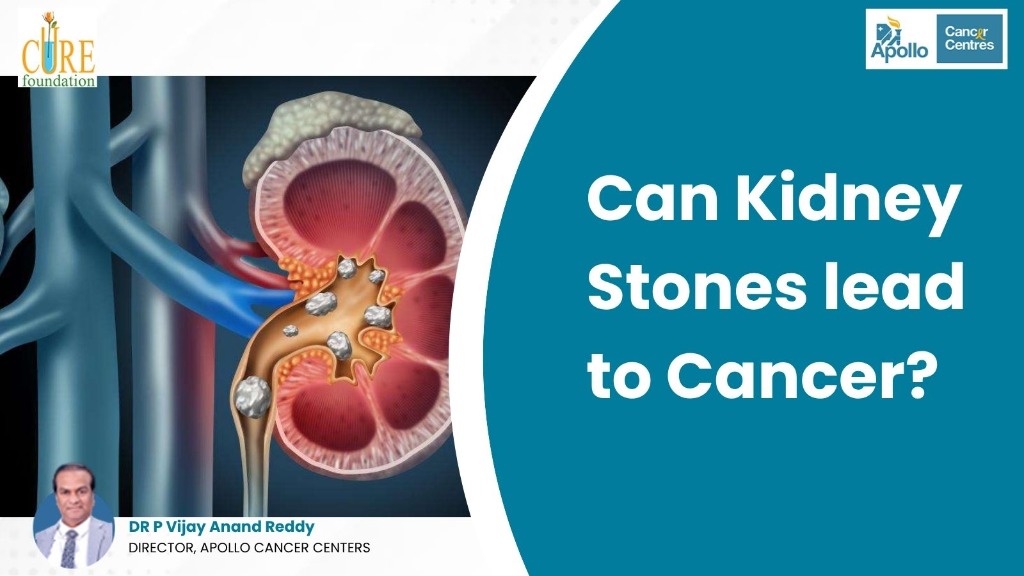
Can Kidney Stones lead to Cancer?
Dr. Vijay Anand Reddy
Consultant Oncologist • AI-Assisted Educational Resource
Medical Disclaimer: This article is AI-assisted and intended for general informational purposes only. It does not replace professional medical advice, diagnosis, or treatment. Please consult a qualified healthcare specialist for advice specific to your condition.
Introduction
When experiencing severe, sharp pain in the back or side, many people immediately suspect kidney issues, often leading to a diagnosis of kidney stones. However, once the initial pain is managed, a deeper concern can arise: can kidney stones lead to cancer? Or, do kidney stones cause cancer?
The quick answer is that kidney stones themselves are benign (non-cancerous) collections of minerals and salts, and they do not directly turn into cancer. However, having chronic, long-term, untreated kidney stones can cause persistent inflammation and irritation in the urinary tract, which scientific research suggests can slightly increase the risk of developing certain types of urological cancers over time. In this comprehensive guide, we will look at the link between kidney stones and cancer, explore whether can kidney stones cause cancer, how to identify kidney stones cancer symptoms, and how you can manage your risks under the guidance of the Best Oncologist in Hyderabad.
Link between kidney stones and cancer
To understand the link, it is important to first distinguish between kidney stones and kidney cancer. Kidney stones are hard, solid deposits made of minerals like calcium, oxalate, and uric acid that crystallize in the kidneys. On the other hand, kidney cancer is a malignancy that occurs when kidney cells undergo genetic mutations, multiplying uncontrollably into a tumor that can invade surrounding tissues.
So, does a kidney stone directly transform into a cancerous tumor? No. A kidney stone is not a pre-cancerous growth. However, there is a statistical association between chronic, recurrent kidney stones and a slightly higher risk of renal cell carcinoma (RCC) and transitional cell carcinoma (TCC) of the renal pelvis. Furthermore, because both conditions can cause blood in the urine and lower back pain, can kidney stones be mistaken for cancer? Yes, they frequently are. A patient might present with symptoms that mimic kidney stones, only for diagnostic tests to reveal an underlying tumor, or vice versa. Therefore, getting a precise diagnosis is essential.
This potential for misdiagnosis makes it critical for patients to seek expert evaluation when experiencing persistent urinary symptoms, ensuring that any serious underlying condition is identified early.
Causes of Kidney Stones and Cancer
While they are distinct medical conditions with separate primary pathways, kidney stones and kidney cancer share several overlapping risk factors and lifestyle causes:
- Obesity: Being overweight alters hormone levels and increases pressure on the kidneys, which is a significant risk factor for both stone formation and renal cell carcinoma.
- High Blood Pressure (Hypertension): Chronic high blood pressure is a well-established risk factor for kidney cancer and is also associated with metabolic changes that promote kidney stones.
- Chronic Kidney Disease (CKD): Long-term kidney dysfunction can lead to mineral imbalances, resulting in stones, and the damaged kidney tissue is more susceptible to cellular mutations.
- Diet and Dehydration: Inadequate water intake is the primary cause of kidney stones. A diet high in processed foods, sodium, and animal proteins can strain the kidneys, creating metabolic environments that favor both stone precipitation and cellular stress.
- Genetic Factors: Certain hereditary conditions, such as Von Hippel-Lindau (VHL) syndrome, increase the risk of kidney cancer, while other genetic predispositions can cause hereditary stone diseases like cystinuria.
Kidney Stones Cancer Symptoms
Because the kidneys are located deep within the abdomen, early-stage issues in these organs are often silent. When symptoms do appear, kidney stones cancer symptoms can look remarkably similar, leading to confusion and potential delay in treatment.
Overlapping Symptoms (Common to both conditions):
- Blood in the Urine (Hematuria): This is the most common symptom. It can make the urine look pink, red, or cola-colored. In kidney stones, blood is caused by the stone scraping the urinary tract lining. In cancer, it is caused by bleeding from the tumor.
- Flank or Back Pain: A persistent, dull ache or sharp, spasmodic pain on one side of the lower back or side, just below the ribs.
- Painful or Frequent Urination: A stone blocking the ureter or a tumor pressing on the urinary tract can cause a constant urge to urinate or discomfort during urination.
Symptoms Unique to Kidney Cancer:
- A Palpable Mass: A lump or swelling that can be felt in the side, back, or abdomen.
- Unexplained Weight Loss and Loss of Appetite: Rapid weight loss without changes in diet or exercise.
- Chronic Fatigue: A persistent, overwhelming feeling of tiredness that doesn't improve with rest.
- Fever and Night Sweats: A persistent fever that is not associated with a cold, flu, or urinary tract infection.
- Anemia: Low red blood cell counts, which can cause pale skin, dizziness, and shortness of breath.
If you are experiencing any of these kidney stones cancer symptoms, especially the unique cancer symptoms, it is essential to seek a complete clinical evaluation to determine the underlying cause.
How do kidney stones increase cancer risk?
If kidney stones are not cancerous, how can they increase the risk of developing malignancy? The primary biological mechanism is chronic, long-term inflammation.
When a patient suffers from large, recurrent, or untreated kidney stones (especially staghorn calculi, which are large, branch-like stones that fill the kidney cavities), the stones constantly rub against the delicate epithelial lining of the renal pelvis and ureters. This causes continuous physical trauma, leading to chronic irritation and recurrent urinary tract infections.
To heal this damage, the body must constantly replace the injured cells. This rapid, continuous cycle of cell division and repair increases the likelihood of genetic copying errors. Over years of chronic irritation, these cellular errors can accumulate, potentially leading to a cancer due to kidney stone irritation. In particular, this chronic irritation is associated with squamous cell carcinoma of the renal pelvis, a rare type of kidney cancer that behaves differently from typical renal cell carcinoma. Thus, while a stone does not directly 'become' cancer, the long-term tissue damage it causes can create a fertile ground for cancer cells to develop.
Diagnosing kidney stones and cancer
Given the overlap in symptoms, a thorough clinical evaluation is necessary to determine if a patient is suffering from a benign stone, a malignant tumor, or both.
Diagnostic techniques include:
- Urinalysis: Checking the urine for blood, infection markers (white blood cells), or mineral crystals.
- Ultrasound: A quick, non-invasive imaging test that can detect hydronephrosis (kidney swelling), larger kidney stones, and solid masses.
- CT Scan (Computed Tomography): A high-resolution CT scan of the abdomen and pelvis is the gold standard. A non-contrast CT is highly sensitive for detecting even tiny kidney stones. If a mass is suspected, a contrast-enhanced CT (or CT Urogram) is performed to evaluate the blood flow and structure of the mass, helping to distinguish a benign cyst or stone from a vascular tumor.
- MRI (Magnetic Resonance Imaging): Used when CT scans are inconclusive, or if contrast dye cannot be used due to poor kidney function. It provides detailed soft-tissue images.
- Blood Tests: Evaluating creatinine and blood urea nitrogen (BUN) levels to check overall kidney function, and performing a complete blood count (CBC) to screen for anemia.
Treatments for kidney stones and cancer
The treatment strategies for kidney stones and kidney cancer are vastly different, depending entirely on the diagnosis:
Treatments for Kidney Stones:
- Conservative Management: Small stones (under 5mm) often pass on their own with increased fluid intake and pain medications.
- Extracorporeal Shock Wave Lithotripsy (ESWL): Uses sound waves to break large stones into tiny pieces that can be passed in urine.
- Ureteroscopy (URS):** A thin scope is passed through the urethra and bladder to retrieve or break up stones in the ureter or kidney using a laser.
- Percutaneous Nephrolithotomy (PCNL): A minimally invasive surgical procedure for very large or complex stones, where a scope is inserted directly into the kidney through a small incision in the back.
Treatments for Kidney Cancer:
- Surgery (Nephrectomy): The primary treatment. A partial nephrectomy removes only the tumor, sparing the rest of the kidney. A radical nephrectomy removes the entire kidney and surrounding tissue.
- Nonsurgical Ablation: For small tumors, cryoablation (freezing) or radiofrequency ablation (heating) can destroy cancer cells without surgery.
- Systemic Therapies: For advanced kidney cancer that has spread, targeted drug therapies and immunotherapies are used to block tumor growth or help the body's immune system fight the disease.
Modern oncological care has advanced significantly. For patients evaluating options, the quality of cancer therapies, including advanced urological oncology and established programs for Oral Cancer treatment in India, matches international standards, offering state-of-the-art care and excellent survival outcomes.
When to Consult a Doctor
Early detection is the key to successfully overcoming kidney issues and cancer. You should seek immediate medical attention if you experience any of the following warning signs:
- Severe, unbearable pain in your back, side, or lower abdomen that does not ease.
- Visible blood in your urine, making it look pink, red, or dark.
- Painful urination accompanied by a high fever, chills, nausea, or vomiting (which indicates a dangerous kidney infection).
- Inability to pass urine, suggesting a complete blockage of the urinary tract.
- An unexplained, persistent dull ache in your side or back that lasts for weeks.
- A palpable lump or mass in your side or abdomen.
- Chronic, unexplained fatigue, night sweats, or sudden weight loss.
Do not ignore recurrent urinary symptoms. Early diagnosis is vital. Consulting a leading specialist like the Best Oncologist in Hyderabad ensures you receive precise testing to rule out serious conditions and get an appropriate treatment plan.
Conclusion
In conclusion, while the question can kidney stones lead to cancer can cause alarm, it is important to understand that kidney stones are not pre-cancerous. They do not directly turn into tumors. However, chronic, neglected, and untreated kidney stones can cause long-term inflammation and tissue damage that slightly increases urological cancer risks.
By staying well-hydrated, maintaining a balanced diet, getting regular check-ups, and addressing kidney stones early, you can protect your kidney function and prevent complications. If you have a history of stones and experience persistent symptoms like blood in your urine or chronic side pain, do not hesitate to seek a comprehensive medical evaluation to safeguard your health.
Frequently Asked Questions (FAQ):
Frequently Asked Questions
Can kidney stones lead to cancer?
Can kidney stones be mistaken for cancer?
Do kidney stones cause cancer directly?
What are the main kidney stones cancer symptoms to watch out for?
Can you have kidney stones and kidney cancer at the same time?
Dr. Vijay Anand Reddy
Dr. Vijay Anand Reddy is a renowned oncologist with over 34 years of experience in cancer treatment. He is committed to providing world-class cancer care and spreading awareness about early detection and prevention.
View Full ProfileRelated Articles
Discover more insights about cancer awareness, treatment options, and patient stories.

Does Oral Cancer Spread? {Quick Guide}

Can a Blood Test Detect Prostate Cancer?

Can Teenagers get Breast Cancer? {2026 Guide}

How Long Can You Live with Blood Cancer Without Treatment?

Is Chemotherapy Painful for Breast Cancer? {Real Facts}
