
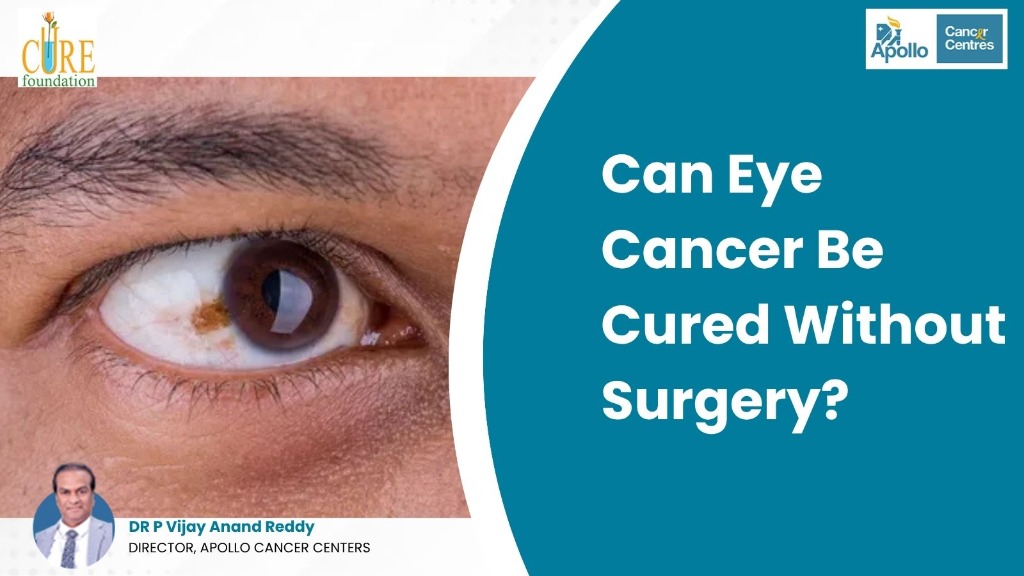
Can Eye Cancer Be Cured Without Surgery?
Dr. Vijay Anand Reddy
Consultant Oncologist • AI-Assisted Educational Resource
Medical Disclaimer: This article is AI-assisted and intended for general informational purposes only. It does not replace professional medical advice, diagnosis, or treatment. Please consult a qualified healthcare specialist for advice specific to your condition.
📌 Quick Summary: Can Eye Cancer Be Cured Without Surgery?
- Curability Without Surgery: Yes. Small to medium-sized eye cancers—including uveal melanoma and retinoblastoma—can be completely cured without removing the eye (enucleation) through advanced non-surgical therapies.
- Primary Non-Surgical Therapies: Plaque Brachytherapy (radioactive plaque), Proton Therapy, Transpupillary Thermotherapy (TTT laser), Intra-Arterial Chemotherapy, and Targeted Therapy.
- Vision Preservation Rate: Over 85–90% of patients treated with plaque brachytherapy or proton beam therapy retain their natural eye globe and useful vision.
- Expert Care: Senior clinical oncologist Dr. Vijay Anand Reddy provides expert ocular oncology evaluations to determine optimal vision-sparing treatment plans.
Understanding Eye Cancer & Modern Vision-Sparing Modalities
Eye cancer (ocular malignancy) refers to tumors originating within the eye structure—most commonly intraocular uveal melanoma, pediatric retinoblastoma, ocular lymphoma, and conjunctival carcinoma. Historically, eye removal (enucleation) was the primary treatment. Today, advancements in precision radiation and interventional oncology allow doctors to cure eye cancer while preserving the eye and visual function.
As senior clinical oncologist Dr. Vijay Anand Reddy explains: "The primary goal of modern ocular oncology is twofold: complete tumor eradication to save the patient's life, and maximum preservation of the natural eye and visual acuity."
Overview: Non-Surgical Eye Cancer Treatment Matrix
| Treatment Modality | Targeted Cancer Type | Curative Mechanism | Eye & Vision Preservation |
|---|---|---|---|
| Plaque Brachytherapy | Small to medium Uveal / Choroidal Melanoma | Custom radioactive gold plaque (Iodine-125) attached to eye wall for 3–7 days | > 90% eye retention; excellent local control |
| Proton Beam Therapy | Choroidal & Iris Melanomas near optic nerve | Charged proton particles deposit energy at Bragg peak with zero exit radiation | High precision; protects optic disc and lens |
| Intra-Arterial Chemotherapy (IAC) | Pediatric Retinoblastoma | Micro-catheter infuses high-dose chemotherapy directly into ophthalmic artery | Prevents enucleation in > 80% of pediatric cases |
| Transpupillary Thermotherapy (TTT) | Small flat choroidal melanomas & retinal lesions | Infrared laser delivers controlled heat to cause tumor cell necrosis | Minimally invasive outpatient procedure |
5 Leading Non-Surgical Modalities to Cure Eye Cancer
1. Plaque Brachytherapy (Internal Radiation Plaque)
Plaque brachytherapy is the gold-standard non-surgical treatment for choroidal melanoma. A tiny gold plaque carrying radioactive seeds (such as Iodine-125 or Ruthenium-106) is temporarily placed against the outer sclera over the tumor. Over several days, it delivers high-dose radiation oncology directly into the cancer while sparing surrounding ocular tissue.
2. Proton Beam Therapy
For tumors positioned close to the optic nerve or macula, Proton Therapy offers sub-millimeter targeted precision. Protons stop precisely at the depth of the tumor (the Bragg peak), preventing radiation from penetrating deeper brain tissue or delicate ocular structures.
3. Intra-Arterial & Intravitreal Chemotherapy for Retinoblastoma
In pediatric retinoblastoma, localized interventional chemotherapy has revolutionized care. Inserting a micro-catheter into the femoral artery up to the ophthalmic artery allows targeted drug delivery, curing childhood eye cancer without requiring total eye removal or systemic toxicity.
4. Transpupillary Thermotherapy (TTT Laser)
TTT utilizes infrared laser light directed through the pupil to heat and destroy small tumors. It is often combined with brachytherapy to ensure complete tumor margin sterilization.
5. Targeted Therapy & Cryotherapy
For superficial conjunctival cancers or specific genetic alterations, targeted molecular drugs and cryotherapy (extreme cold freezing) destroy abnormal tumor cells while protecting healthy corneal tissue. Read more about Targeted Therapy advances.
When Is Surgery Still Required?
While non-surgical treatments are highly effective for small to medium tumors, surgical removal of the eye (enucleation) remains necessary in specific circumstances:
- Very large tumors occupying over half the internal eye volume.
- Tumors causing severe, irreversible loss of vision accompanied by intractable pain or secondary neovascular glaucoma.
- Cases where non-surgical therapies have failed or tumor recurrence poses a threat of systemic spread.
Expert Ocular Oncology Care with Dr. Vijay Anand Reddy
Determining the right non-surgical treatment path requires specialized evaluation by an experienced clinical oncologist.
Dr. Vijay Anand Reddy, Director of Apollo Cancer Centres, Hyderabad, brings over 34 years of international clinical experience in radiation oncology and multidisciplinary cancer management. Dr. Reddy collaborates closely with ocular oncologists and retina specialists to deliver state-of-the-art plaque brachytherapy, proton therapy, and targeted systemic treatments—ensuring world-class curative care while preserving vision whenever possible.
Conclusion
Eye cancer can indeed be cured without surgery in many cases. Thanks to breakthrough non-surgical treatments like plaque brachytherapy, proton beam therapy, laser thermotherapy, and intra-arterial chemotherapy, patients with small to medium-sized eye tumors can achieve complete cancer eradication while preserving their natural eye and vision. Consulting an experienced clinical oncologist ensures access to personalized, vision-sparing treatment strategies.
Frequently Asked Questions
Can eye cancer be cured without removing the eye (enucleation)?
Yes. Modern non-surgical treatments—such as radioactive plaque brachytherapy, Proton Therapy, and laser thermotherapy—achieve complete tumor control while saving the eye globe and preserving natural vision in over 85–90% of small to medium-sized intraocular tumors.
What is Plaque Brachytherapy for eye cancer and how does it work?
Plaque Brachytherapy involves temporarily attaching a customized gold disc (plaque) containing radioactive seeds (Iodine-125 or Ruthenium-106) to the outer eye wall over the tumor. It delivers intense, targeted radiation oncology over 3 to 7 days to destroy cancer cells while sparing healthy surrounding tissues.
How is pediatric Retinoblastoma treated without surgical eye removal?
Retinoblastoma in children is frequently cured using Intra-Arterial Chemotherapy (IAC), where chemotherapy is infused directly into the ophthalmic artery via a micro-catheter. This achieves high tumor destruction while avoiding systemic side effects and surgical enucleation.
What role does Proton Beam Therapy play in non-surgical eye cancer treatment?
Proton Therapy uses subatomic particles with a precision Bragg peak to deliver curative radiation doses directly to iris or choroidal melanomas without exit dose, protecting the optic nerve and cornea.
What is Transpupillary Thermotherapy (TTT)?
TTT is a specialized infrared laser treatment that uses heat to destroy cancer cells in small choroidal melanomas or retinoblastomas. It is often combined with plaque brachytherapy to enhance local tumor destruction.
Are there side effects associated with non-surgical eye cancer treatments?
Potential side effects include temporary dry eye syndrome, radiation-induced cataracts, or mild retinal vascular changes. Regular ophthalmology follow-ups allow oncologists to monitor and treat these side effects effectively.
When is surgery (enucleation) still necessary for eye cancer?
Surgical removal of the eye (enucleation) is reserved for very large advanced tumors occupying more than half the eye volume, cases causing severe unmanageable glaucoma/pain, or when there is high risk of extraocular metastasis.
Where can patients get advanced non-surgical eye cancer treatment in Hyderabad?
Comprehensive ocular oncology evaluations, plaque brachytherapy coordination, precision radiation, and targeted therapy are led by senior clinical oncologist Dr. Vijay Anand Reddy at Apollo Cancer Centres, Hyderabad.
Dr. Vijay Anand Reddy
Dr. Vijay Anand Reddy is a renowned oncologist with over 34 years of experience in cancer treatment. He is committed to providing world-class cancer care and spreading awareness about early detection and prevention.
View Full ProfileRelated Articles
Discover more insights about cancer awareness, treatment options, and patient stories.

Does Oral Cancer Spread? {Quick Guide}

Can a Blood Test Detect Prostate Cancer?

Can Teenagers get Breast Cancer? {2026 Guide}

How Long Can You Live with Blood Cancer Without Treatment?

Is Chemotherapy Painful for Breast Cancer? {Real Facts}
