
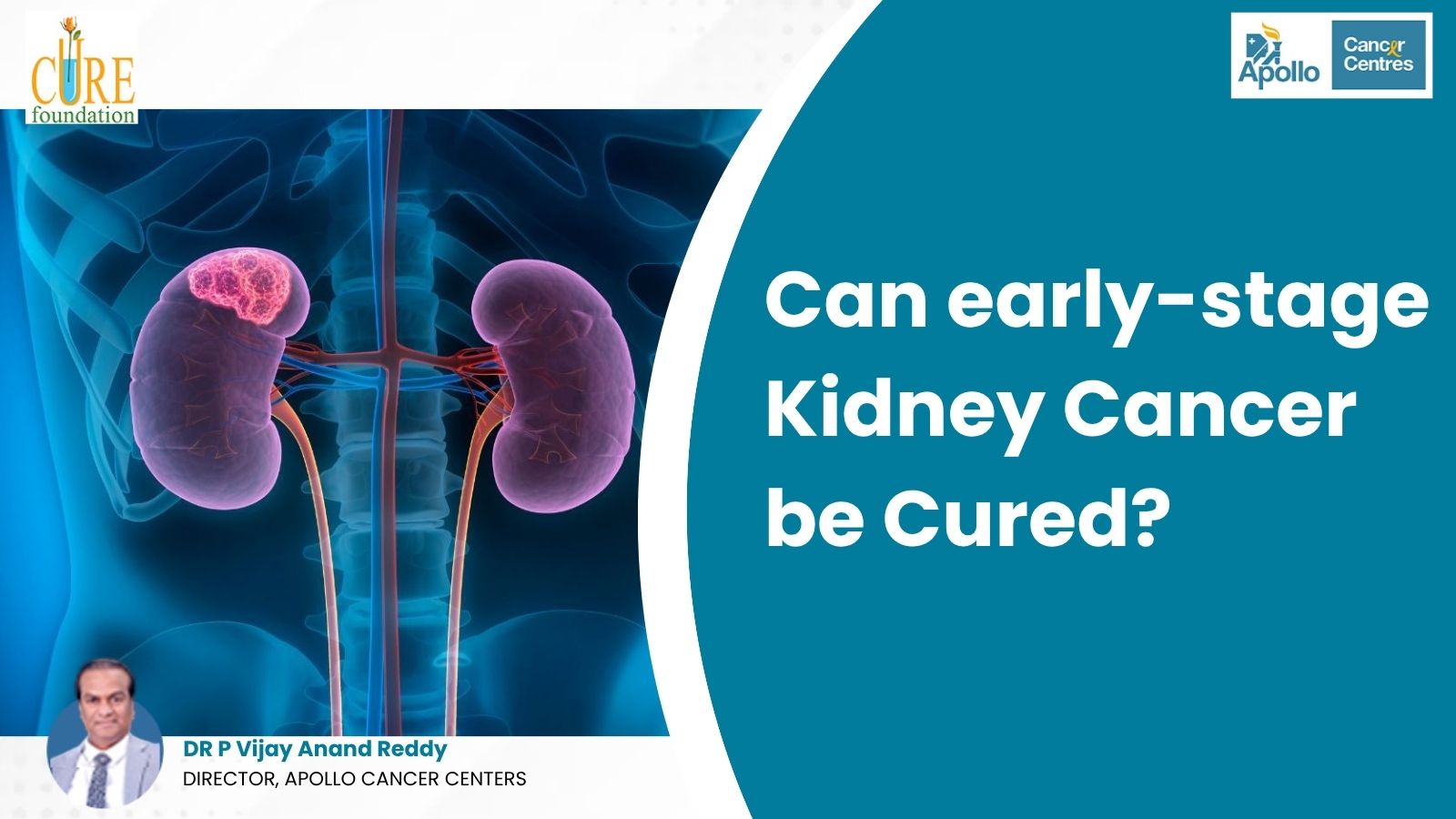
Can early-stage Kidney Cancer be Cured?
Dr. Vijay Anand Reddy
Consultant Oncologist • AI-Assisted Educational Resource
Medical Disclaimer: This article is AI-assisted and intended for general informational purposes only. It does not replace professional medical advice, diagnosis, or treatment. Please consult a qualified healthcare specialist for advice specific to your condition.
Yes, early-stage kidney cancer can be cured in the vast majority of patients. When renal cell carcinoma (RCC) is diagnosed in Stage 1 or Stage 2—while the tumor remains localized strictly within the kidney—treatments like partial nephrectomy, radical nephrectomy, or thermal ablation achieve 5-year cure and survival rates between 90% and 95%. Early detection allows complete surgical removal of the tumor, preserving normal renal function and offering patients a long-term, cancer-free life.
Introduction: Understanding Early-Stage Kidney Cancer
Receiving any cancer diagnosis is a life-altering moment that brings immense emotional distress, uncertainty, and urgent questions regarding treatment outcomes, overall survival, and long-term quality of life. For individuals diagnosed with localized renal masses, one question dominates every discussion: can early-stage kidney cancer be cured?
The reassuring medical truth is that kidney cancer detected in its initial stages is among the most treatable and highly curable of all adult solid organ malignancies. Thanks to widespread access to modern diagnostic imaging modalities—such as routine abdominal ultrasonography, high-resolution computed tomography (CT), and magnetic resonance imaging (MRI)—kidney tumors are increasingly detected at an early phase. In fact, more than 60% of kidney cancers today are identified incidentally during medical workups for unrelated complaints before any physical symptoms develop.
When a renal tumor is confined entirely within the protective anatomical boundaries of the kidney capsule, surgical intervention can completely resect the lesion, providing a definitive cure. Patients seeking specialized oncology evaluation and state-of-the-art treatment can consult renowned radiation oncologist Dr. Vijay Anand Reddy, Director of Apollo Cancer Centres, for world-class Kidney Cancer treatment in Hyderabad. In this comprehensive medical guide, we examine the staging definitions, scientific cure statistics, surgical innovations, risk factors, and long-term recovery pathways for early kidney cancer.
Seeking Expert Kidney Cancer Evaluation?
Consult Dr. Vijay Anand Reddy at Apollo Cancer Centres for precise diagnostic staging, nephron-sparing surgical guidance, and personalized oncology care.
Book Your Consultation Today →What Defines Early-Stage Kidney Cancer? (Stage 1 vs. Stage 2 Detailed Breakdown)
To understand why cure is achievable, it is essential to clarify what medical oncologists mean by "early-stage" kidney cancer. According to global oncology literature on Kidney Cancer, primary malignant tumors of the kidney originate in the lining of the microscopic renal tubules responsible for filtering blood and producing urine. This form of cancer is known medically as renal cell carcinoma (RCC) and accounts for over 90% of all adult kidney tumors.
Staging for renal cell carcinoma relies on the TNM (Tumor, Node, Metastasis) system. "Early-stage" kidney cancer encompasses Stage 1 and Stage 2 disease, where the malignant growth is localized exclusively inside the kidney organ:
Stage 1 Kidney Cancer (Small Localized Tumor)
In Stage 1, the tumor measures 7 centimeters (approximately 2.75 inches) or smaller across its largest dimension and has not spread beyond the kidney envelope (renal capsule). Stage 1 is further subdivided into two sub-categories:
- Stage 1A: The tumor is 4 centimeters (about 1.5 inches) or smaller. These small renal masses have an exceptionally high Stage 1 kidney cancer cure rate exceeding 95% when treated promptly.
- Stage 1B: The tumor measures between 4 centimeters and 7 centimeters in diameter, but remains completely encapsulated within the renal tissue without invading nearby blood vessels or lymph nodes.
Stage 2 Kidney Cancer (Larger Localized Tumor)
In Stage 2, the tumor has grown larger than 7 centimeters in diameter, but it remains strictly contained within the kidney tissue. Importantly, it has not breached Gerota’s fascia (the outer layer of connective tissue enclosing the kidney and adrenal gland), nor has it extended into the main renal vein, vena cava, regional lymph nodes, or distant body organs. Stage 2 is subdivided into:
- Stage 2A: The tumor is larger than 7 centimeters but not more than 10 centimeters across.
- Stage 2B: The tumor measures greater than 10 centimeters in size, but remains entirely localized within the kidney.
Despite their larger physical dimensions, Stage 2 tumors retain a strong cure rate of 75% to 88% following complete surgical removal.
Can Early-Stage Kidney Cancer Be Cured? The Scientific Evidence & Survival Rates
When evaluated from a clinical standpoint, early-stage kidney cancer is considered highly curable. The primary reason for this high cure potential lies in the anatomical isolation of the kidney during initial tumor growth. In Stage 1 and Stage 2 disease, malignant cells have not established vascular or lymphatic channels outside the organ. Consequently, complete surgical removal of the tumor removes 100% of the cancerous cells from the patient’s body.
Clinical survival statistics published by international cancer registries highlight the exceptional kidney tumor survival rate achieved with timely treatment:
- Stage 1 Five-Year Relative Survival Rate: 93% to 97%. The vast majority of Stage 1 patients treated surgically remain completely cancer-free for the rest of their lives.
- Stage 2 Five-Year Relative Survival Rate: 75% to 88%. Surgical resection offers long-term disease-free survival for most Stage 2 patients.
- Comparison with Advanced Disease: In stark contrast, Stage 4 metastatic kidney cancer (where malignant cells have spread to distant organs like lungs, bone, or brain) carries a 5-year survival rate of approximately 15% to 20%. This dramatic difference underlines why early detection of kidney cancer is the single most critical factor in achieving a permanent cure.
Curative Treatment Options for Early-Stage Kidney Cancer
Surgery is the cornerstone of treatment and the only definitive curative therapy for localized kidney cancer. Unlike many other solid organ tumors (such as breast, lung, or colon cancer), localized renal cell carcinoma is largely resistant to traditional chemotherapy and standard radiation therapy. Therefore, surgical resection provides the definitive cure.
Depending on tumor size, precise location, anatomical depth, patient age, and baseline kidney function, oncologists select from several curative treatment modalities:
1. Partial Nephrectomy (Nephron-Sparing Surgery)
Partial nephrectomy is the gold-standard surgical approach for Stage 1A and select Stage 1B kidney tumors (typically up to 4 to 7 cm). In this procedure, the surgeon removes only the tumor along with a thin margin of healthy tissue surrounding it, preserving the rest of the healthy kidney organ.
By saving healthy filtering units (nephrons), partial nephrectomy maintains long-term renal function and reduces the risk of chronic kidney disease (CKD) and secondary cardiovascular complications. Clinical studies confirm that partial nephrectomy delivers overall cure rates identical to total kidney removal for small renal masses.
2. Radical Nephrectomy
Radical nephrectomy involves the complete surgical removal of the affected kidney, along with the surrounding layer of fatty tissue (Gerota’s fascia) and occasionally the adjacent adrenal gland or regional lymph nodes.
This procedure is recommended for larger Stage 2 tumors, complex masses located deep in the central renal hilum near major blood vessels, or cases where partial nephrectomy is technically impossible. The human body is naturally equipped with two kidneys, and a person can live a completely normal, healthy, and active life with a single functioning kidney.
3. Thermal Ablation Therapy (RFA & Cryoablation)
For elderly patients, individuals with significant cardiac or pulmonary co-morbidities, or those with compromised baseline kidney function, ablation therapy for kidney cancer provides an effective minimally invasive curative alternative. Under real-time CT or ultrasound guidance, specialized needle probes are inserted directly into small kidney tumors (usually ≤ 3 cm):
- Radiofrequency Ablation (RFA): High-frequency electrical energy generates thermal heat, destroying malignant cells.
- Cryoablation: Sub-zero freezing gases (argon and helium) circulate through probes to freeze and shatter cancer cells.
4. Active Surveillance
For small kidney masses (under 2 to 3 cm) detected in frail or elderly patients, immediate surgical intervention may pose a greater risk than the tumor itself. Active surveillance involves closely monitoring tumor size using serial ultrasound or CT imaging every 3 to 6 months. Because many small clear cell renal cell carcinomas grow very slowly (averaging 2 to 4 mm per year), active surveillance defers surgery until significant growth occurs.
Surgical Innovations: Robotic vs. Laparoscopic vs. Open Surgery
Modern surgical oncology has evolved significantly over the past two decades. Today, most partial and radical nephrectomies are performed using advanced minimally invasive techniques rather than traditional open surgery:
- Robotic-Assisted Surgery: Using state-of-the-art robotic surgical systems (such as the da Vinci robotic platform), surgeons operate through keyhole incisions with 3D high-definition magnification and 360-degree wristed instrument maneuverability. Robotic partial nephrectomy allows ultra-precise tumor excision, minimal warm ischemia time, rapid renal repair, reduced blood loss, and faster return to normal activities.
- Laparoscopic Surgery: Uses specialized long instruments and HD cameras inserted through small abdominal incisions. Laparoscopic radical nephrectomy offers excellent surgical visualization, faster wound healing, and minimal post-operative discomfort compared to open surgery.
- Open Surgery: Reserved for exceptionally large Stage 2 tumors, extensive inferior vena cava thrombus extension, or complex re-do surgical cases where minimally invasive access is anatomically unsafe.
Treatment Comparison: Early Kidney Cancer Modalities
The comparative table below summarizes the key clinical parameters, indications, organ preservation capabilities, and recovery expectations associated with primary early kidney cancer treatments:
| Treatment Option | Primary Clinical Indication | 5-Year Cure Rate | Organ Preservation | Typical Recovery Time |
|---|---|---|---|---|
| Partial Nephrectomy | Stage 1A & 1B tumors (≤4–7 cm), exophytic location. | Excellent (92%–96%). | High (Preserves non-cancerous renal tissue). | 2 to 3 weeks (Robotic/Lap). |
| Radical Nephrectomy | Stage 2 tumors (>7 cm) or central hilar masses. | High (80%–88%). | None (Removes affected kidney entirely). | 3 to 5 weeks. |
| Thermal Ablation (RFA/Cryo) | Small masses (≤3 cm) in elderly or high-risk surgical patients. | Good (85%–90% local control). | Very High (Targeted needle destruction). | 1 to 2 weeks. |
| Active Surveillance | Very small masses (<2–3 cm) in elderly/frail patients. | Monitored (Surgery deferred until growth). | Full preservation during monitoring period. | Non-invasive serial imaging. |
Risk Factors & Causes of Kidney Cancer
Understanding the risk factors associated with renal cell carcinoma can assist in early risk assessment and lifestyle modification. While many kidney cancers develop spontaneously without an obvious cause, several established risk factors increase probability:
- Cigarette Smoking: Tobacco smoke doubles the risk of developing renal cell carcinoma. The risk declines over time after quitting.
- High Blood Pressure (Hypertension): Chronic hypertension is an independent risk factor for kidney tumors, regardless of medication use.
- Obesity: Excess body weight alters hormone levels and metabolic pathways, significantly increasing kidney cancer risk.
- Chronic Kidney Disease & Dialysis: Patients on long-term dialysis treatment have a higher incidence of acquired cystic disease and renal tumors.
- Family History & Inherited Syndromes: Genetic disorders such as Von Hippel-Lindau (VHL) disease, Hereditary Papillary RCC, and Birt-Hogg-Dubé syndrome account for 5% to 8% of all kidney cancers.
- Occupational Exposure: Chronic exposure to industrial chemicals like cadmium, asbestos, and organic solvents.
Symptoms of Early Kidney Cancer & How It Is Diagnosed
Early-stage kidney cancer is notorious for being asymptomatic. Because the kidneys are located deep in the retroperitoneal cavity behind the abdominal organs, small tumors do not cause physical pain or visible distortion.
However, as tumors expand, subtle symptoms of early kidney cancer may manifest:
- Blood in Urine (Hematuria): Urine may appear rusty, pink, or dark cola-colored. Hematuria can be intermittent and painless.
- Flank Pain: A constant, dull ache in the side or lower back between the ribs and hip.
- Palpable Abdominal Mass: A firm swelling or lump felt in the side or abdomen.
- Unexplained Weight Loss & Fatigue: Chronic tiredness, loss of appetite, or unintentional weight loss.
- Persistent Low-Grade Fever: Fever unrelated to cold, flu, or systemic infection.
The Diagnostic Workflow
When a kidney lesion is suspected, urologists and oncologists use a precise sequence of diagnostic investigations:
- Abdominal Ultrasound: Initial screening scan that differentiates fluid-filled benign kidney cysts from solid tumor masses.
- Multiphase Contrast-Enhanced CT Scan: The gold-standard imaging modality. CT imaging confirms tumor contrast enhancement, exact measurements, hilar anatomy, and venous involvement.
- MRI (Magnetic Resonance Imaging): Used when patients are allergic to CT contrast dye, have renal impairment, or require detailed evaluation of renal vein blood flow.
- Renal Mass Biopsy: Unlike breast or prostate cancer, routine pre-operative biopsy is not always mandatory for solid enhancing kidney masses because imaging criteria are highly accurate. Biopsy is performed primarily before ablation therapy or active surveillance.
Key Factors That Impact the Probability of a Permanent Cure
While clinical stage is the single most decisive factor, several pathological and biological tumor characteristics influence long-term cure probability:
- Histological Subtype: Clear cell renal cell carcinoma (75%-80% of cases) responds predictably to complete surgical resection. Papillary RCC and chromophobe RCC also demonstrate excellent post-surgical outcomes in early stages.
- Fuhrman / ISUP Nuclear Grade: Pathologists examine tumor cells under a microscope and assign a grade from 1 to 4. Lower-grade tumors (Grades 1 and 2) are less aggressive and carry significantly lower recurrence rates than Grade 3 or 4 tumors.
- Surgical Margins: Achieving clear negative surgical margins (R0 resection) ensures that no residual malignant cells remain at the incision site.
- Microvascular Invasion: The absence of microscopic tumor invasion into tiny capsular blood vessels confirms low recurrence risk.
Advanced Kidney Cancer Care in Hyderabad
Apollo Cancer Centres provides world-class robotic nephrectomy, precision radiation therapy, targeted therapies, and dedicated follow-up care.
Schedule Your Consultation →Life After Treatment: Recovery, Surveillance & Preserving Kidney Health
Following successful surgical treatment for early kidney cancer, patients can look forward to a healthy, active lifespan. However, ongoing post-treatment surveillance and proactive kidney preservation strategies remain essential:
- Post-Surgical Surveillance Schedule: Patients undergo periodic abdominal imaging (ultrasound, CT, or MRI) and chest X-rays every 6 to 12 months for the first 5 years post-surgery to confirm continued disease-free status.
- Renal Function Monitoring: Regular blood tests (serum creatinine, estimated glomerular filtration rate or eGFR) and urine tests ensure that single-kidney or partial-kidney filtration remains healthy.
- Hydration & Fluid Intake: Maintaining good daily hydration (2 to 3 liters of water daily) supports renal clearance and prevents urinary tract stress.
- Blood Pressure Control: Managing blood pressure within healthy limits (below 130/80 mmHg) protects delicate renal nephrons from hypertensive injury.
- Avoiding Nephrotoxic Drugs: Patients should avoid frequent overuse of nonsteroidal anti-inflammatory drugs (NSAIDs like ibuprofen, naproxen, or diclofenac) and consult their doctor before taking new medications or herbal supplements.
- Healthy Dietary Habits: Adopting a low-sodium, nutrient-dense diet rich in antioxidants and fresh vegetables helps maintain cardiovascular and renal health long into the future.
Why Consult Dr. Vijay Anand Reddy for Kidney Cancer Treatment in Hyderabad?
Navigating a kidney cancer diagnosis requires seasoned clinical expertise, sophisticated diagnostic facilities, and individualized treatment planning. As Director of Apollo Cancer Centres, Dr. Vijay Anand Reddy brings over 30 years of clinical oncology leadership, having managed thousands of complex cancer cases with exceptional cure outcomes.
At Apollo Cancer Centres, patients seeking Kidney Cancer treatment in Hyderabad receive multidisciplinary tumor board reviews, advanced robotic surgical options, precision radiation techniques (IMRT/IGRT), and dedicated post-operative care, ensuring maximum cure rates with optimal quality of life.
Conclusion
In conclusion, to answer the critical question—can early-stage kidney cancer be cured?—the medical outlook is exceptionally positive. Stage 1 and Stage 2 localized kidney tumors achieve 5-year cure rates between 80% and 95% when managed promptly with surgical modalities like partial or radical nephrectomy.
Early detection remains the single most decisive factor in conquering renal cell carcinoma. If you or a family member have received an unexpected diagnosis of a renal mass or experience unexplained flank pain or hematuria, do not delay medical evaluation. Consult Dr. Vijay Anand Reddy for comprehensive evaluation and expert Kidney Cancer treatment in Hyderabad.
Frequently Asked Questions
Q1. Is Stage 1 kidney cancer 100% curable?
While no medical outcome can be guaranteed at 100%, Stage 1 kidney cancer has a remarkably high 5-year cure rate of 90% to 95% following complete surgical removal (partial or radical nephrectomy). Most Stage 1 patients remain disease-free permanently.
Q2. Can you live a normal life with one kidney after radical nephrectomy?
Yes. The remaining healthy kidney automatically adapts through compensatory hypertrophy to handle the body’s filtration demands. Individuals with one kidney can live a completely normal, healthy, and active lifespan with routine hydration and blood pressure management.
Q3. Does early-stage kidney cancer require chemotherapy or radiation?
No. Early-stage localized kidney cancer (Stage 1 and Stage 2) is primarily treated with surgery (nephrectomy) alone. Chemotherapy and radiation therapy are generally reserved for advanced, recurrent, or metastatic cases because localized RCC responds best to complete surgical resection.
Q4. How fast does early-stage kidney cancer grow?
Most early renal cell carcinomas grow slowly, averaging about 3 to 5 millimeters per year. However, growth rates vary depending on cell grade and histological subtype, which is why prompt medical evaluation and regular imaging are essential.
Q5. What is the recurrence rate after early kidney cancer surgery?
The recurrence rate for Stage 1 kidney cancer after complete surgical removal is low, typically around 5% to 10%. For Stage 2, the recurrence risk is slightly higher (15% to 20%), which is why routine follow-up CT scans are scheduled for 5 years post-surgery.
Q6. What is the difference between partial nephrectomy and radical nephrectomy?
Partial nephrectomy removes only the kidney tumor while leaving the rest of the healthy kidney intact. Radical nephrectomy removes the entire kidney containing the tumor along with surrounding fat tissue.
Q7. Can kidney cancer return years after being cured?
While uncommon, kidney cancer can occasionally recur years after initial treatment. Long-term surveillance with periodic imaging ensures that any late recurrence is detected early and treated effectively.
Q8. When should I consult Dr. Vijay Anand Reddy for kidney cancer evaluation?
You should schedule a consultation immediately if an abdominal ultrasound or CT scan reveals an incidental renal mass, if you observe blood in your urine, or if you require an expert second opinion on surgical treatment options for kidney cancer.
Frequently Asked Questions
Is Stage 1 kidney cancer 100% curable?
Can you live a normal life with one kidney after radical nephrectomy?
Does early-stage kidney cancer require chemotherapy or radiation?
How fast does early-stage kidney cancer grow?
What is the recurrence rate after early kidney cancer surgery?
What is the difference between partial nephrectomy and radical nephrectomy?
Can kidney cancer return years after being cured?
When should I consult Dr. Vijay Anand Reddy for kidney cancer evaluation?
Dr. Vijay Anand Reddy
Dr. Vijay Anand Reddy is a renowned oncologist with over 34 years of experience in cancer treatment. He is committed to providing world-class cancer care and spreading awareness about early detection and prevention.
View Full ProfileRelated Articles
Discover more insights about cancer awareness, treatment options, and patient stories.

Does Oral Cancer Spread? {Quick Guide}

Can a Blood Test Detect Prostate Cancer?

Can Teenagers get Breast Cancer? {2026 Guide}

How Long Can You Live with Blood Cancer Without Treatment?

Is Chemotherapy Painful for Breast Cancer? {Real Facts}
