
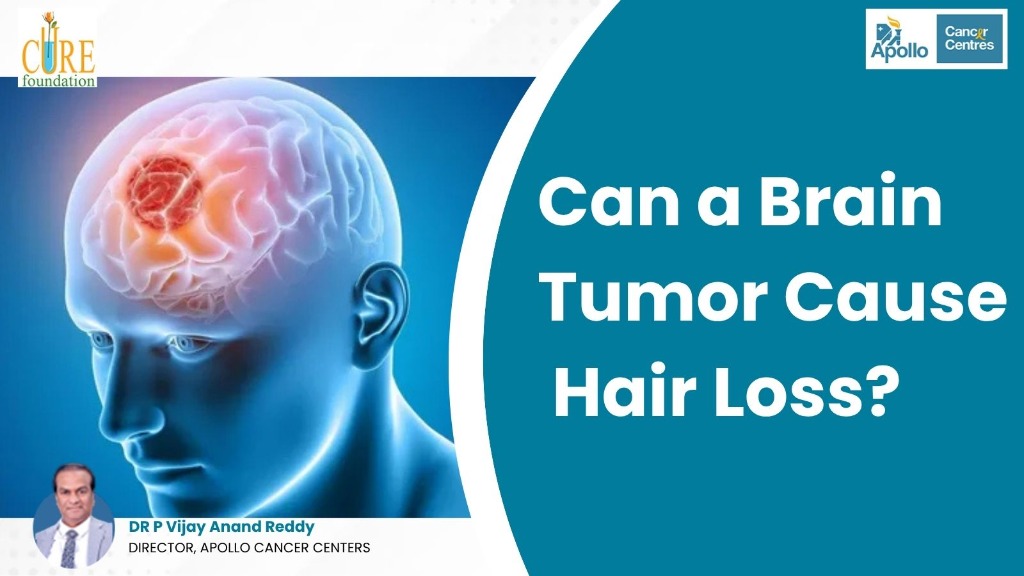
Can a Brain Tumor Cause Hair Loss?
Dr. Vijay Anand Reddy
Consultant Oncologist • AI-Assisted Educational Resource
Medical Disclaimer: This article is AI-assisted and intended for general informational purposes only. It does not replace professional medical advice, diagnosis, or treatment. Please consult a qualified healthcare specialist for advice specific to your condition.
No, a brain tumor itself does not directly cause hair loss in the vast majority of cases. Hair loss is almost never a primary symptom or an early warning sign of a brain tumor. Instead, hair loss due to brain tumor care occurs primarily as a side effect of cancer treatments—such as localized cranial radiation therapy, chemotherapy, scalp shaving before craniotomy surgery, or severe physical and emotional stress. The only rare exception occurs when a pituitary tumor disrupts hormone production, which can cause secondary hair thinning.
Introduction: Understanding Brain Tumors and Hair Loss
When individuals or their loved ones notice sudden hair thinning or scalp hair loss, panic and anxiety can easily set in. In the age of online medical searches, many people worry about severe underlying conditions, asking: can a brain tumor cause hair loss? Or is hair loss a warning sign of a dangerous neurological condition?
Understanding the distinction between tumor symptoms and treatment side effects is crucial for patient clarity and peace of mind. A brain tumor is an abnormal growth of cells within the tissue of the brain or central nervous system. Because brain tissue and scalp hair follicles operate under completely separate anatomical systems, the growth of a brain tumor inside the skull does not directly affect the growth cycle of your hair.
However, patients diagnosed with brain tumors frequently experience hair loss during their medical journey. This occurs because treatments such as radiation therapy, chemotherapy, brain surgery, and corticosteroid medications exert a major impact on hair follicles. If you or a family member are seeking answers regarding neurological symptoms, specialized diagnostic evaluations, or advanced radiation oncology treatments, consulting a trusted Brain Tumor Specialist in Hyderabad like Dr. Vijay Anand Reddy ensures access to compassionate, world-class medical expertise.
Concerned About Brain Tumor Symptoms or Treatment?
Get comprehensive evaluation, advanced radiation therapy, and personalized neuro-oncology care from Dr. Vijay Anand Reddy at Apollo Cancer Centres, Hyderabad.
Book Your Consultation Today →Does a Brain Tumor Directly Cause Hair Loss?
To address the fundamental question—does brain tumor cause hair loss directly?—medical consensus is clear: primary brain tumors (such as gliomas, meningiomas, acoustic neuromas, and glioblastomas) do not destroy or shed scalp hair follicles as they grow.
Hair growth is regulated by biological signals within hair dermal papillae, blood supply to the scalp, and endocrine hormones. Since most brain tumors develop deep within the central nervous system beneath the skull (cranium), they have no direct physical contact with the skin or hair follicles.
The Exception: Pituitary Gland Tumors and Hormonal Imbalance
The single rare scenario where a brain tumor cause hair loss directly involves tumors of the pituitary gland (pituitary adenomas). The pituitary gland sits at the base of the brain and regulates essential body hormones, including thyroid-stimulating hormone (TSH), adrenocorticotropic hormone (ACTH), and sex hormones.
If a pituitary adenoma impairs normal hormone secretion or produces excess hormones (such as in Cushing's disease or hyperprolactinemia), it can trigger secondary hormonal imbalances leading to diffuse hair thinning, brittle hair, or androgenetic alopecia. However, even in these endocrine cases, hair loss is accompanied by distinct hormonal symptoms such as unexplained weight fluctuations, fatigue, or menstrual irregularities.
Why Do Brain Tumor Patients Experience Hair Loss? Main Clinical Causes
If a brain tumor itself is not the direct culprit, why is hair shedding so strongly associated with brain tumor diagnoses? The answer lies in the intense medical and surgical treatments required to control or eliminate brain tumors. Hair loss due to brain tumor management stems from five distinct medical mechanisms:
1. Radiation Therapy to the Brain (Cranial Irradiation)
Radiation therapy is one of the most effective non-surgical tools for treating brain tumors. High-energy X-ray or proton beams target tumor cells to halt their division. However, as radiation beams pass through the scalp to reach the brain, rapidly dividing hair follicle cells within the treatment path absorb radiation energy.
- Localized Hair Loss: Unlike chemotherapy, radiation-induced hair loss is localized strictly to the area of the scalp where the radiation beam enters and exits.
- Temporary vs. Permanent Hair Loss: At standard radiation doses (under 30 to 45 Gray), hair loss is usually temporary, with regrowth beginning 2 to 4 months post-treatment. At higher radiation doses (above 50 to 60 Gray), hair follicles may suffer permanent damage, leading to permanent scalp thinning or patchy hair loss in the irradiated area.
2. Surgical Preparation & Craniotomy Incisions
When a neurosurgeon performs a craniotomy to resect a brain tumor, a portion of the scalp hair surrounding the surgical site must be shaved to maintain sterile surgical conditions. Following surgery, scar tissue along the incision line may prevent hair follicles from re-establishing growth, resulting in a thin line of permanent hair absence along the surgical scar.
3. Chemotherapy & Targeted Medications
Chemotherapy medications like temozolomide (commonly used for high-grade gliomas and glioblastomas), vincristine, or PCV combination regimens circulate through the bloodstream to kill cancer cells. Chemotherapy causes hair follicles throughout the entire scalp to enter a resting phase (anagen effluvium), causing generalized hair thinning or complete hair loss across the head and body.
4. Corticosteroids (Dexamethasone)
Brain tumor patients are frequently prescribed potent anti-inflammatory steroids like dexamethasone to reduce swelling (edema) in surrounding brain tissue. Prolonged corticosteroid use can alter hormone levels, leading to hair thinning, skin changes, and altered hair texture.
5. Severe Physiological & Emotional Stress (Telogen Effluvium)
Receiving a brain tumor diagnosis and undergoing brain surgery creates immense physical and emotional stress. Major physiological trauma triggers a condition called telogen effluvium, where a large number of active hair follicles prematurely shift into the shedding phase. This causes noticeable hair loss approximately 2 to 3 months after the initial stress event or surgery.
Is Hair Loss a Sign of a Brain Tumor? What You Need to Know
Many people searching online want to know: is hair loss a sign of brain tumor? The clear medical answer is no. Hair loss on its own is never considered a primary diagnostic sign or symptom of a brain tumor.
Common causes of everyday hair loss include male or female pattern baldness (androgenetic alopecia), nutritional deficiencies (iron, vitamin D, or B12 deficiency), thyroid disorders, stress, or autoimmune alopecia areata. Experiencing hair shedding without neurological symptoms is almost certainly related to non-cancerous scalp or metabolic factors.
Instead of hair loss, actual early warning signs and clinical symptoms of a brain tumor include:
- Persistent Headaches: Severe, worsening headaches that are typically worse in the early morning or awaken you from sleep.
- Unexplained Nausea and Vomiting: Nausea accompanying headaches due to increased intracranial pressure.
- Seizures or Convulsions: Sudden onset of unprovoked seizures or muscle twitching in an adult with no prior history of epilepsy.
- Neurological Deficits: Progressive weakness, numbness, or tingling on one side of the face or body.
- Vision or Hearing Disturbances: Blurred vision, double vision, loss of peripheral vision, or sudden hearing changes.
- Cognitive & Personality Changes: Unexplained confusion, memory loss, speech difficulties, or dramatic mood shifts.
If you or a loved one experience any of these neurological warning signs, immediate medical evaluation by an experienced Brain Tumor Specialist in Hyderabad like Dr. Vijay Anand Reddy is essential for accurate brain imaging (MRI/CT) and early diagnosis.
Comparison: Types of Hair Loss in Brain Tumor Patients
The table below breaks down the different causes of hair shedding in patients managing brain tumors, highlighting patterns, timelines, and regrowth expectations:
| Hair Loss Category | Primary Mechanism | Pattern & Extent | Regrowth Timeline |
|---|---|---|---|
| Cranial Radiation Therapy | Radiation energy damaging active hair follicles in beam path. | Localized patch matching the radiation field on scalp. | Regrowth starts 2–4 months post-treatment (permanent at high doses >50 Gy). |
| Chemotherapy (Temozolomide / PCV) | Cytotoxic drug disruption of rapidly dividing hair cells. | Generalized thinning or widespread scalp shedding. | Hair begins regrowing 1–3 months after completing chemotherapy cycles. |
| Surgical Preparation (Craniotomy) | Pre-operative hair shaving & surgical scar formation. | Shaved region around incision; thin permanent scar line. | Shaved areas regrow normally; scar line remains hairless. |
| Pituitary Gland Tumors | Hormonal dysregulation (TSH, ACTH, or sex hormones). | Diffuse hair thinning across scalp with hormonal symptoms. | Improves after medical or surgical correction of hormone levels. |
| Stress-Induced (Telogen Effluvium) | Physical trauma of surgery & emotional stress of diagnosis. | Diffuse shedding noticed 2–3 months post-surgery. | Full regrowth expected within 6–12 months as body recovers. |
Tips for Managing Scalp Care & Hair Loss During Brain Tumor Treatment
Experiencing hair loss during brain tumor care can affect emotional well-being and self-esteem. Adopting practical scalp care habits helps protect sensitive skin and promotes healthy regrowth:
- Use Gentle Scalp Products: Wash your hair and scalp with mild, fragrance-free, or baby shampoos. Avoid harsh chemical dyes, perms, or heat-styling tools during and immediately after radiation or chemotherapy.
- Protect Your Scalp from Sun & Cold: Irradiated scalp skin is extra sensitive. Wear soft cotton headscarves, wide-brimmed hats, or apply broad-spectrum sunscreen when outdoors to prevent sunburn.
- Avoid Pulling or Tightly Styling Hair: Use soft brushes or wide-toothed combs, and avoid tight braids, ponytails, or hair extensions that pull on delicate hair roots.
- Sleep on Soft Pillowcases: Satin or silk pillowcases minimize friction on the scalp while sleeping, reducing hair breakage.
- Discuss Scalp Care with Your Oncology Team: Always consult your radiation oncologist before using hair growth oils, minoxidil, or scalp ointments during active radiation treatment to avoid skin reactions.
Leading Brain Tumor Treatment & Precision Radiation in Hyderabad
Consult Dr. Vijay Anand Reddy at Apollo Cancer Centres for state-of-the-art IMRT, IGRT, and stereotactic radiosurgery designed to maximize tumor control while sparing healthy tissue.
Schedule an Appointment →Consulting a Premier Brain Tumor Specialist in Hyderabad
Managing a brain tumor requires comprehensive, multidisciplinary care combining neurosurgery, radiation oncology, medical oncology, and supportive care. Modern advancements in precision radiation techniques—such as Intensity-Modulated Radiation Therapy (IMRT), Image-Guided Radiation Therapy (IGRT), and Stereotactic Radiosurgery (SRS)—allow radiation oncologists to deliver lethal radiation doses to brain tumors while minimizing exposure to surrounding healthy brain tissue and hair-bearing scalp regions.
With over 30 years of clinical leadership in oncology, Dr. Vijay Anand Reddy, Director of Apollo Cancer Centres, is recognized as a leading Brain Tumor Specialist in Hyderabad. Patients receiving care under Dr. Vijay Anand Reddy benefit from cutting-edge treatment protocols, personalized side-effect management, and dedicated support throughout their recovery journey.
Conclusion & Final Key Takeaways
In summary, to answer the key query—can a brain tumor cause hair loss?—a brain tumor itself does not directly cause scalp hair loss in almost all patients, with the rare exception of pituitary tumors that disrupt hormone production.
Instead, hair loss experienced by brain tumor patients is a side effect of essential treatments like cranial radiation therapy, chemotherapy, surgical shaving, or physical and emotional stress. In most cases, treatment-induced hair loss is temporary, and healthy hair regrowth begins within a few months after therapy concludes.
If you are concerned about persistent headaches, seizures, or vision changes, do not hesitate to seek immediate medical advice. For expert brain tumor diagnosis, precision radiation therapy, and compassionate oncology care, schedule a consultation with Dr. Vijay Anand Reddy at Apollo Cancer Centres, Hyderabad.
Frequently Asked Questions
Can a brain tumor cause hair loss before any treatment is started?
Is hair loss a sign of brain tumor in adults or children?
Will hair grow back after radiation therapy for a brain tumor?
Why does radiation therapy cause hair loss only on parts of the scalp?
Can pituitary gland tumors cause hair thinning?
Does temozolomide chemotherapy cause complete hair loss?
How long after brain tumor surgery does shaved hair take to grow back?
Who should I consult for expert brain tumor treatment in Hyderabad?
Dr. Vijay Anand Reddy
Dr. Vijay Anand Reddy is a renowned oncologist with over 34 years of experience in cancer treatment. He is committed to providing world-class cancer care and spreading awareness about early detection and prevention.
View Full ProfileRelated Articles
Discover more insights about cancer awareness, treatment options, and patient stories.

Does Oral Cancer Spread? {Quick Guide}

Can a Blood Test Detect Prostate Cancer?

Can Teenagers get Breast Cancer? {2026 Guide}

How Long Can You Live with Blood Cancer Without Treatment?

Is Chemotherapy Painful for Breast Cancer? {Real Facts}

8th Edition of WHITATHON
Get in Touch
Ready to start your healing journey? Contact us today.
Phone
+91-9676720002
Location
Apollo Cancer Centre, Jubilee Hills, Hyderabad