
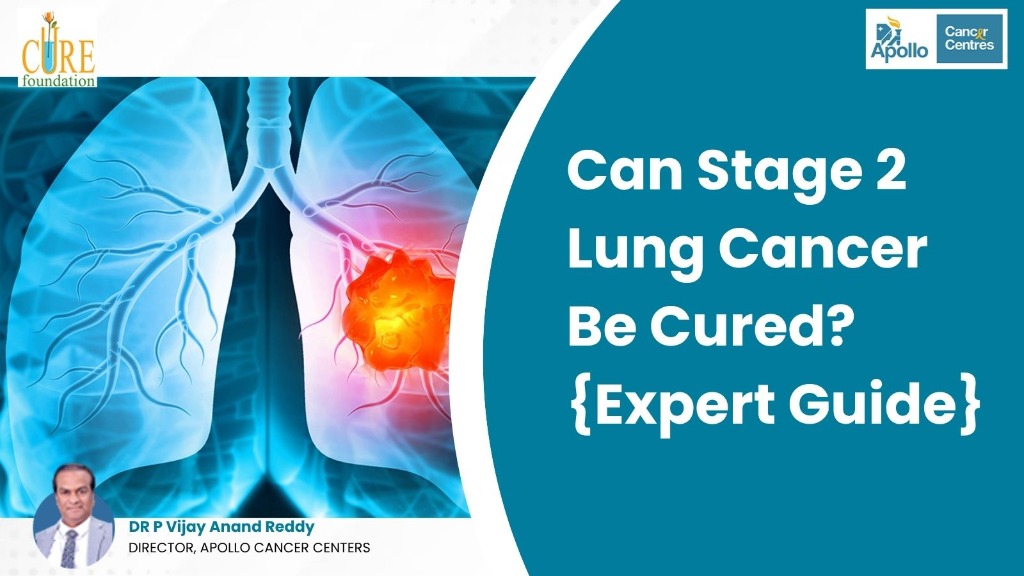
Can Stage 2 Lung Cancer Be Cured? {Expert Guide}
Dr. Vijay Anand Reddy
Consultant Oncologist • AI-Assisted Educational Resource
Medical Disclaimer: This article is AI-assisted and intended for general informational purposes only. It does not replace professional medical advice, diagnosis, or treatment. Please consult a qualified healthcare specialist for advice specific to your condition.
Quick Answer: Can Stage 2 Lung Cancer Be Cured?
Yes, Stage 2 lung cancer is considered curable with timely, aggressive multimodal treatment. In Stage 2 non-small cell lung cancer (NSCLC), the primary tumor is larger (typically 4cm to 7cm) or has spread to nearby bronchopulmonary or hilar lymph nodes on the same side of the chest, but has not reached distant organs or mediastinal nodes. Complete surgical resection (lobectomy) combined with adjuvant chemotherapy, targeted molecular therapy, or immunotherapy yields 5-year survival rates of 50% to 60%, with many patients achieving permanent cure.
Receiving a diagnosis of Stage 2 lung cancer is serious, but it is critical to understand that Stage 2 is still an early to intermediate, localized stage of disease. Unlike Stage 4 (metastatic) lung cancer where cancer cells have spread to distant body sites like the brain, bone, or liver, Stage 2 lung cancer remains confined to the chest cavity and is amenable to definitive curative treatment strategies.
Advances in thoracic surgical techniques, high-precision radiation oncology, targeted therapies for genetic mutations (such as EGFR and ALK), and immune checkpoint inhibitors have dramatically improved prognosis and cure rates for Stage 2 patients. In this expert guide, senior clinical oncologist Dr. Vijay Anand Reddy provides a comprehensive breakdown of Stage 2 lung cancer staging, curability statistics, multimodal treatment plans, and post-treatment survival strategies.
Understanding Stage 2 Lung Cancer: Substage Definitions (TNM Classification)
Lung cancer staging follows the international TNM (Tumor size, Nodal involvement, Metastasis) staging system. Stage 2 Non-Small Cell Lung Cancer is divided into two distinct substages:
1. Stage 2A Lung Cancer
In Stage 2A, the tumor meets one of the following pathological criteria:
- The primary tumor measures between 4 cm and 5 cm in diameter, and has not spread to any regional lymph nodes (T2b, N0, M0).
- The tumor is small (≤ 3 cm), but cancer cells have spread to nearby lymph nodes inside the lung or hilar region on the same side as the primary tumor (T1a-c, N1, M0).
2. Stage 2B Lung Cancer
Stage 2B represents slightly more advanced localized growth:
- The primary tumor measures between 5 cm and 7 cm in diameter without lymph node spread (T3, N0, M0).
- The primary tumor measures between 3 cm and 5 cm and has spread to nearby hilar lymph nodes on the same side (T2a-b, N1, M0).
- The tumor has invaded adjacent structures such as the chest wall, phrenic nerve, or parietal pleura, but has not involved lymph nodes.
Curability & 5-Year Survival Statistics for Stage 2 Lung Cancer
In medical oncology, "cure" is defined as achieving complete disease remission with no cancer recurrence over 5 or more years post-treatment. According to international thoracic oncology registries, the overall 5-year relative survival rate for Stage 2 NSCLC is approximately 50% to 60%.
Breakdown by substage reveals:
- Stage 2A NSCLC: 5-year survival rate of approximately 56% to 65% when complete surgical resection and adjuvant therapy are achieved.
- Stage 2B NSCLC: 5-year survival rate of approximately 45% to 53%.
It is important to note that historical survival statistics often lag behind modern medical breakthroughs. With the integration of routine biomarker testing, neoadjuvant immunotherapy, and targeted maintenance therapies, contemporary real-world cure rates are steadily increasing.
Comparison Table: Stage 2 Substage Characteristics & Curative Pathways
| Substage | Tumor Size (T) | Lymph Node Status (N) | 5-Year Survival Rate | Primary Curative Treatment Pathway |
|---|---|---|---|---|
| Stage 2A (Option 1) | 4 cm to 5 cm | N0 (No lymph node spread) | 56% - 65% | Lobectomy + Adjuvant Systemic Therapy |
| Stage 2A (Option 2) | ≤ 3 cm | N1 (Hilar nodes, same side) | 55% - 62% | Neoadjuvant / Adjuvant Chemo + Surgery |
| Stage 2B (Option 1) | 5 cm to 7 cm | N0 (No lymph node spread) | 48% - 55% | Surgery + Adjuvant Chemotherapy / Targeted Therapy |
| Stage 2B (Option 2) | 3 cm to 5 cm | N1 (Hilar nodes, same side) | 45% - 52% | Multimodal Surgery + Chemo-Immunotherapy |
| Non-Surgical Candidates | Stage 2 (Inoperable) | N0 or N1 | 40% - 50% | Curative SBRT Radiation + Immunotherapy |
Multimodal Treatment Strategies to Cure Stage 2 Lung Cancer
Achieving a permanent cure in Stage 2 lung cancer requires a coordinated, aggressive multimodal treatment plan implemented by a specialized multidisciplinary tumor board:
1. Curative Surgical Resection (Lobectomy)
Surgery remains the cornerstone of curative intent for eligible Stage 2 patients. The gold-standard surgical procedure is a lobectomy—removing the entire lobe of the lung containing the primary tumor, along with a thorough dissection of hilar and mediastinal lymph nodes. Minimal-access techniques, such as Video-Assisted Thoracoscopic Surgery (VATS) or Robotic-Assisted Thoracic Surgery (RATS), reduce recovery times and postoperative complications.
2. Adjuvant & Neoadjuvant Chemotherapy
Even when surgery completely removes the visible lung tumor, microscopic circulating cancer cells may remain in distant tissues. Chemotherapy (typically a platinum-based doublet such as Cisplatin + Pemetrexed or Vinorelbine) given after surgery (adjuvant) or before surgery (neoadjuvant) reduces 5-year recurrence risk by 10% to 15%.
3. Targeted Molecular Therapy
Comprehensive biomarker testing (Next-Generation Sequencing) is performed on all Stage 2 tumor tissue biopsies. Patients whose tumors harbor specific driver mutations—such as EGFR exon 19 deletions or ALK gene rearrangements—receive adjuvant targeted therapy (such as Osimertinib or Alectinib). Adjuvant targeted therapy dramatically lowers recurrence risk compared to traditional chemotherapy alone.
4. Immunotherapy Checkpoint Inhibitors
Immunotherapy drugs (such as Pembrolizumab or Atezolizumab) block PD-1/PD-L1 protein pathways that cancer cells use to hide from the immune system. Administering neoadjuvant immunotherapy combined with chemotherapy prior to surgery helps shrink Stage 2 tumors and induces a complete pathologic response (pCR) in a significant percentage of patients.
5. Stereotactic Body Radiation Therapy (SBRT) for Non-Surgical Patients
For patients who cannot undergo surgery due to underlying medical conditions (such as severe COPD or heart disease), high-precision radiation oncology using Stereotactic Body Radiation Therapy (SBRT) or Intensity-Modulated Radiation Therapy (IMRT) delivers ablative radiation doses directly to the tumor with curative intent.
Factors That Influence Your Odds of Being Cured
Individual prognosis in Stage 2 lung cancer depends on several key clinical parameters:
- Complete Surgical Margins (R0 Resection): Ensuring that no microscopic cancer cells remain at the cut edges of surgical tissue is essential for long-term cure.
- Biomarker Status (EGFR, ALK, PD-L1): Tumors with actionable genetic targets carry higher long-term survival rates when targeted maintenance drugs are utilized.
- Smoking Cessation: Patients who stop smoking completely prior to and after surgery experience significantly lower recurrence rates, better lung function recovery, and higher overall survival.
- Patient Overall Health & Performance Status: Good baseline cardiopulmonary health enables patients to tolerate full therapeutic doses of chemotherapy and radiation without interruption.
Post-Treatment Surveillance: Monitoring for Recurrence
Following successful curative treatment for Stage 2 lung cancer, rigorous post-treatment surveillance is essential. Patients undergo regular clinical follow-up visits and low-dose chest CT scans every 3 to 6 months during the first 2 years, and every 6 to 12 months thereafter up to 5 years. Catching any potential local recurrence early allows for immediate curative second-line interventions.
Conclusion & Expert Thoracic Oncology Care in Hyderabad
In summary, Stage 2 lung cancer is a highly treatable and curable condition when managed with modern, aggressive multimodal care. Early surgical resection combined with personalized adjuvant chemotherapy, targeted molecular therapies, and immunotherapy offers patients a strong path toward long-term survival and permanent cure. Under the clinical leadership of senior oncologist Dr. Vijay Anand Reddy, Director at Apollo Cancer Centres, Hyderabad, patients receive world-class, comprehensive thoracic oncology care and individualized treatment planning tailored to their unique diagnosis.
Frequently Asked Questions
Is Stage 2 lung cancer curable?
Yes, Stage 2 lung cancer is considered curable. Because the tumor remains localized within the lung or nearby hilar lymph nodes without distant metastasis, complete surgical removal combined with chemotherapy, targeted therapy, or immunotherapy yields 5-year survival rates between 50% and 60%.
What is the 5-year survival rate for Stage 2 lung cancer?
The 5-year relative survival rate for Stage 2 non-small cell lung cancer ranges from 50% to 60%. Stage 2A carries a 56% to 65% survival rate, while Stage 2B carries a 45% to 53% survival rate with optimal treatment.
What is the standard treatment for Stage 2 lung cancer?
The primary curative treatment is surgical lobectomy (removing the affected lung lobe and lymph nodes) followed by adjuvant chemotherapy or targeted therapy. Patients who cannot undergo surgery receive curative Stereotactic Body Radiation Therapy (SBRT).
Does Stage 2 lung cancer require chemotherapy after surgery?
Yes. Adjuvant chemotherapy (given after surgery) is standard for Stage 2 lung cancer. It destroys microscopic circulating cancer cells that may remain in the body, reducing 5-year recurrence risk by 10% to 15%.
What is the difference between Stage 2A and Stage 2B lung cancer?
Stage 2A tumors are 4 to 5 cm without node spread, or smaller than 3 cm with hilar node spread. Stage 2B tumors are 5 to 7 cm without node spread, or 3 to 5 cm with hilar node involvement.
Can Stage 2 lung cancer come back after surgery?
Recurrence can occur if microscopic cells survived initial treatment. However, adding adjuvant targeted therapy (like Osimertinib) or immunotherapy significantly lowers 5-year recurrence rates.
Is targeted therapy effective for Stage 2 lung cancer?
Yes. For Stage 2 patients whose tumors test positive for genetic mutations like EGFR or ALK, adjuvant targeted therapies dramatically improve disease-free survival and long-term cure rates compared to chemo alone.
Where can I get expert Stage 2 lung cancer treatment in Hyderabad?
Comprehensive thoracic cancer surgery, precision radiotherapy, molecular profiling, and immunotherapy are provided under senior oncologist Dr. Vijay Anand Reddy at Apollo Cancer Centres, Hyderabad.
Dr. Vijay Anand Reddy
Dr. Vijay Anand Reddy is a renowned oncologist with over 34 years of experience in cancer treatment. He is committed to providing world-class cancer care and spreading awareness about early detection and prevention.
View Full ProfileRelated Articles
Discover more insights about cancer awareness, treatment options, and patient stories.

Does Oral Cancer Spread? {Quick Guide}

Can a Blood Test Detect Prostate Cancer?

Can Teenagers get Breast Cancer? {2026 Guide}

How Long Can You Live with Blood Cancer Without Treatment?

Is Chemotherapy Painful for Breast Cancer? {Real Facts}
